More Than Words: The Communication Skills That Shape Our Lives.
Why listening, understanding, adapting and navigating conversations deserve greater attention in education.
A teenager walks into a classroom and has to judge whether this is a good moment to ask the teacher a question.
Later, they need to join a group conversation without interrupting.
At lunchtime, a friend says, “I’m fine”, although their voice and expression suggest otherwise.
After school, there is a disagreement in a group chat.
A few years later, that same young person may be expected to walk into an interview, talk to an unfamiliar adult and explain why they should be given an opportunity.
These situations look very different.
But they all rely on communication.
And much of the knowledge required to navigate them is rarely taught explicitly.
Communication is more than talking.
We sometimes talk about communication as if it is primarily about speaking clearly and confidently.
It is much more complicated than that.
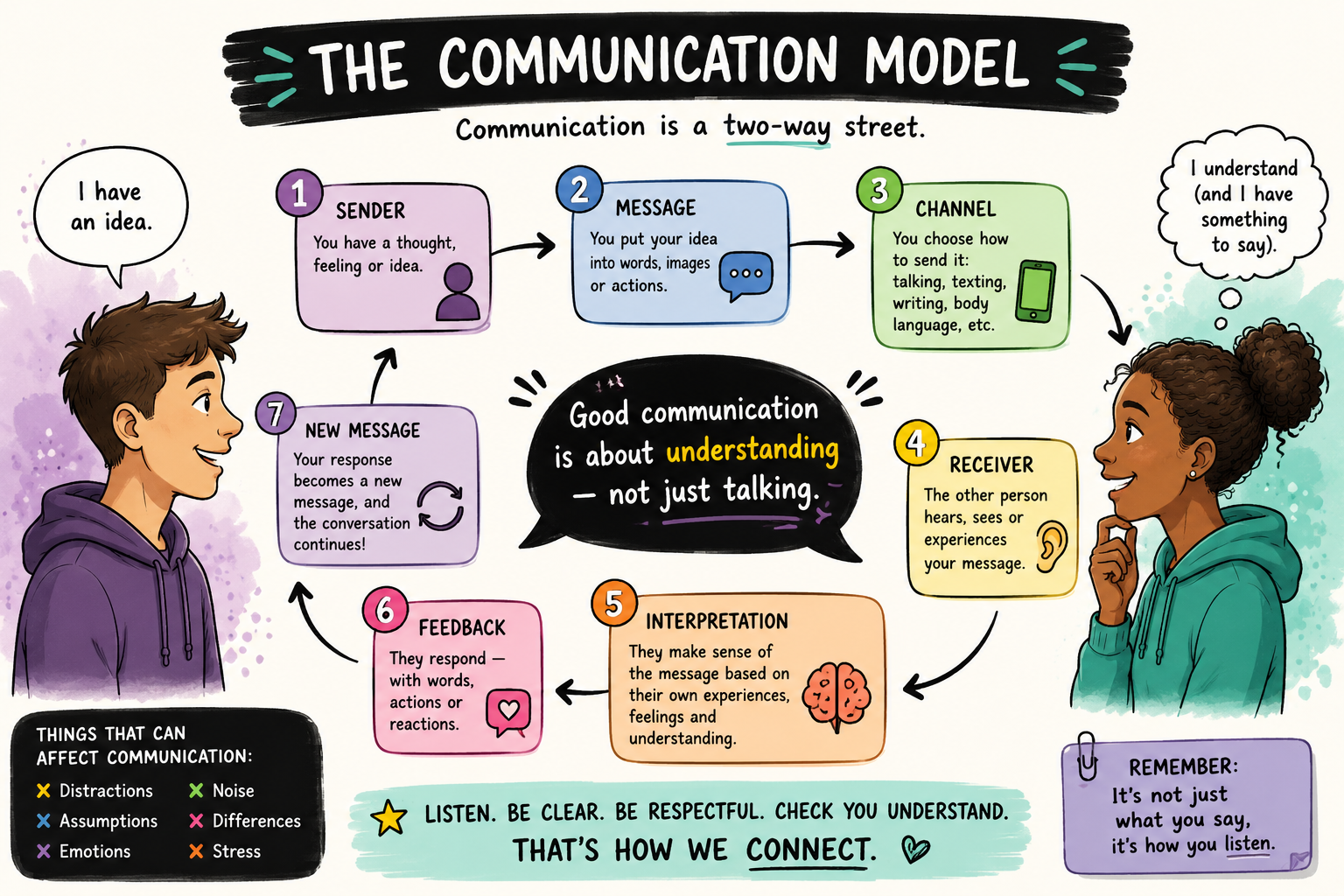
Successful communication involves listening, interpreting, responding, noticing misunderstandings, repairing conversations, managing emotion, understanding different perspectives and adapting to different people and situations.
Most importantly, communication happens between people.
When we say something, what we mean isn’t always the same as what another person understands. We interpret what other people say through context, previous experience, tone, assumptions and our shared knowledge.
That is why two perfectly competent communicators can leave the same conversation with completely different understandings of what just happened.
The hidden curriculum of communication
Children learn an enormous amount about communication simply by participating in everyday life.
They learn through play, family conversations, friendships, games, disagreements, jokes, mistakes, school, activity clubs and, increasingly, through digital communication.
We might think of this as a kind of communication apprenticeship. Through thousands of everyday interactions, young people gradually learn how conversations work and how communication changes across people and situations.
But this learning is largely incidental. We experience it, rather than necessarily being taught how or why it works.
And even young people who appear confident communicators can find things much harder when situations become unfamiliar, emotionally charged or high-stakes.
Adolescence also makes the communication environment considerably more complicated.
Relationships become more nuanced. Language becomes more subtle. Peer expectations change. Young people are increasingly expected to advocate for themselves, negotiate independence, manage disagreement and take responsibility for their own interactions.
Eventually, we expect them to communicate successfully in further education and employment.
Yet, we rarely stop and explain what is actually happening in those conversations.
What if we taught communication, rather than just expecting it to happen?
This is a question I have become increasingly interested in.
I have spent more than 40 years working as a Speech and Language Therapist, much of that time supporting children and young people for whom communication is difficult.
My doctoral research explored talk-in-interaction in autistic young people, and throughout my clinical work I have become increasingly interested not simply in individual communication “skills”, but in what happens between people.
How do we know when it is our turn?
How do we recognise that somebody hasn't understood us?
What do we do when a conversation begins to go wrong?
How do we listen to somebody whose view is different from our own?
How do we say no?
How do we ask for help?
How do we negotiate?
What happens to our communication when we are anxious, angry or under pressure?
And how do we adapt when the person in front of us communicates differently from us?
These are not simply social niceties.
They are part of navigating everyday life.
And many of them can be explored and taught explicitly.
Better understanding means more choice
There is an important distinction here.
Teaching communication should not mean teaching young people that there is one “correct” way to communicate.
It shouldn't mean requiring eye contact, encouraging every quiet teenager to become more outgoing or teaching neurodivergent young people to imitate a particular version of socially acceptable behaviour.
People communicate differently.
Personality matters. Culture matters. Context matters. Neurodiversity matters.
But young people can benefit from understanding how communication works and how different people may interpret the same interaction.
That understanding gives them choices.
A young person might choose to ask for clarification rather than pretend they have understood.
They might recognise that a conversation is escalating and decide to pause.
They might be able to say, “I need a minute to think.”
They might realise that somebody else's short answer does not necessarily mean that person is angry.
They might understand why a different amount of information is useful when talking to a friend, a teacher or an interviewer.
The aim isn't conformity.
It is communicative agency — understanding what is happening and having a greater range of options for what to do next.
Why does this matter in education?
There is growing interest in speaking, listening and oracy within education, and good reason for it.
But I think the conversation can go further.
Communication doesn't belong neatly to one subject.
It affects learning and classroom participation, but also friendships and relationships.
It affects behaviour and conflict.
It affects self-advocacy.
It affects inclusion.
And eventually it affects how a young person navigates further education, interviews, work and adult life.
Perhaps that is precisely why it can remain hidden.
Everybody needs it, so we assume young people will acquire it.
Communication for Life
These questions have led me to begin developing an evidence-informed curriculum for young people called Communication for Life.
The curriculum is still in its early stages, and I think that is important to say: I don't want to create another programme that promises to “teach social skills” or implies that successful communication means behaving in one prescribed way.
Instead, I want to explore what happens when we help young people understand communication itself.
Listening.
Non-verbal communication.
Different communication styles.
Misunderstanding and repair.
Difficult conversations.
Negotiation.
Communication under pressure.
Self-advocacy.
And communication beyond school.
The next stage will involve scrutinising the evidence, working with educators and young people, and exploring how to teach and evaluate these ideas meaningfully.
But the starting point is simple.
Life happens through conversations.
Perhaps we should teach how those conversations work more explicitly.
Join the conversation
Communication for Life is still in development, and I’m particularly interested in hearing from educators and other professionals working with young people, and most importantly, from young people themselves.
What communication skills do you think young people most need for life beyond the classroom? And which do we currently expect them to acquire without explicitly teaching them?
If this is something you’re thinking about in your school or setting, I’d be very interested to hear from you.
If you are a young person who finds communication difficult, what do you want to be able to do?
Get in touch to share your thoughts or start a conversation.