

The Hidden Communication Demands of the School Day
I remember starting my ‘dream job’.
I was already an experienced therapist. I was well qualified, the work was exactly what I wanted to do, and I was excited to get started.
I arrived bright-eyed and bushy-tailed, determined to do the job well and make a good impression on my new colleagues.
A few weeks later, I felt desolate.
I was exhausted, overwhelmed and tearful. I began looking for quiet spaces where I could be on my own and finding excuses to avoid social situations. I dreaded going into work.
And no one knew.
From the outside, I was still turning up and doing my job. What people couldn’t see was how much effort it was taking.
The problem wasn’t that I lacked the knowledge or skills to do the work. For a while, the demands of the situation simply exceeded the resources I had available to manage them.
Everything was new. I was trying to remember things, understand expectations, read other people, make decisions, organise my time, solve problems and make a good impression – all at once.
Eventually, after taking some time off, I began to break things down. I set more realistic expectations, asked for help and learned to manage my time and environment in ways that reduced the sense of overwhelm.
Gradually, my confidence returned. I came to love the job.
I often think about that experience when I see children struggling at school.
What if the problem isn’t the child – but the demand?
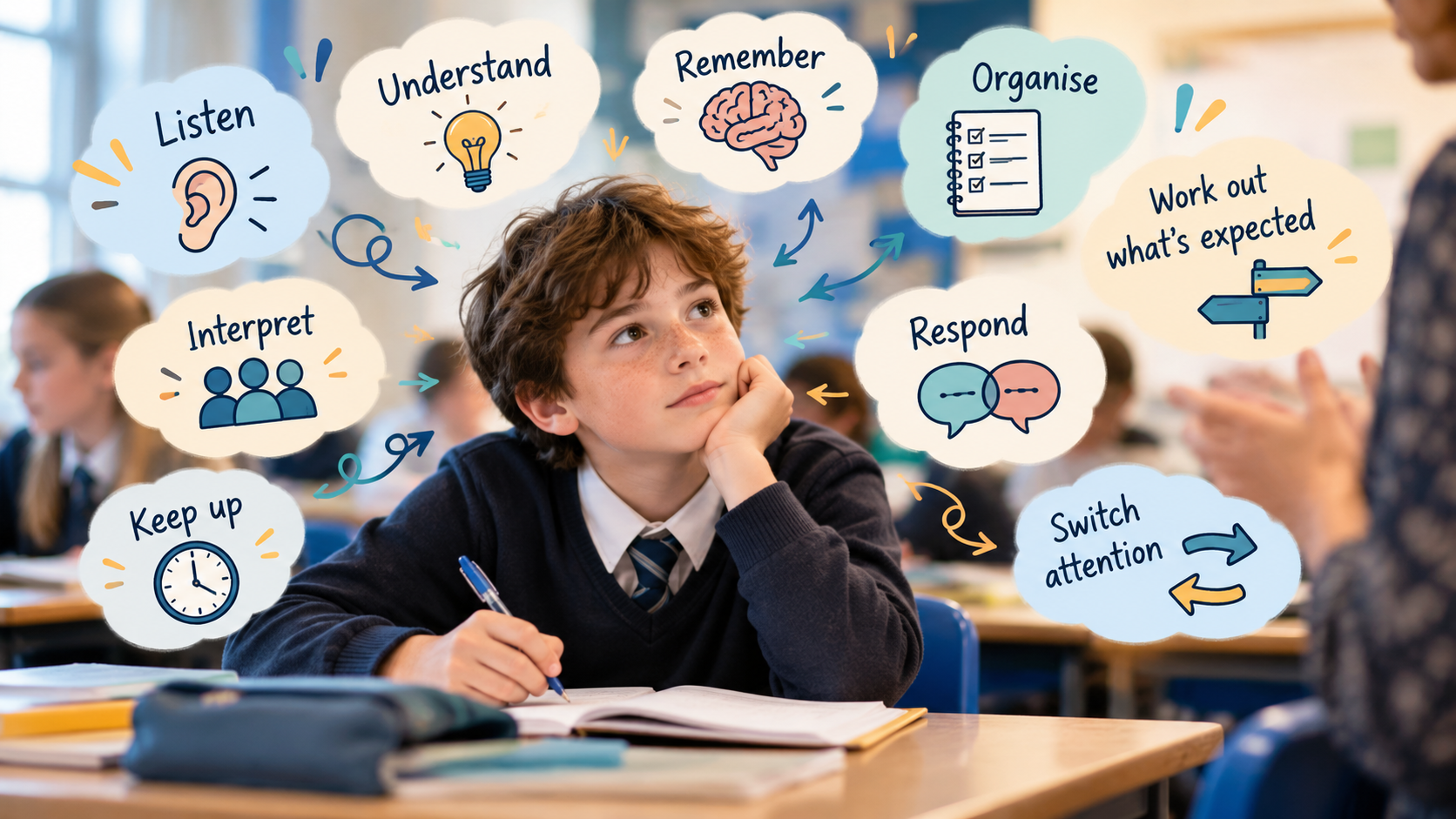
Most children adapt to the routines and expectations of school fairly quickly. For some, however, the experience may be rather like mine.
They may have the underlying ability to succeed. They may desperately want to succeed. They may even appear to be coping.
But the cumulative demands of the school day can exceed the communication resources they have available at that particular moment.
And those resources aren’t fixed.
Our ability to listen, understand, remember, organise our thoughts and communicate effectively changes when we are tired, anxious, distracted, overwhelmed, surrounded by noise or unsure what is expected of us.
That is true for adults. It is also true for children.
An ordinary instruction isn’t always ordinary
Consider this apparently simple classroom instruction:
“I want you to finish the questions you didn’t do yesterday, then get your planner out and write down the homework while I’m giving these books out.”
For many pupils, this will present no difficulty. But look at what the pupil actually has to do.
attend to the teacher’s speech;
understand the vocabulary and grammar;
work out what “the questions you didn’t do” refers to;
retain several pieces of information in working memory;
put the actions into the correct sequence;
shift attention from one activity to another;
begin one task while remembering what they need to do next;
potentially continue listening while the teacher moves on to something else.
There is a surprisingly complex communication and cognitive demand hidden inside one very ordinary instruction.
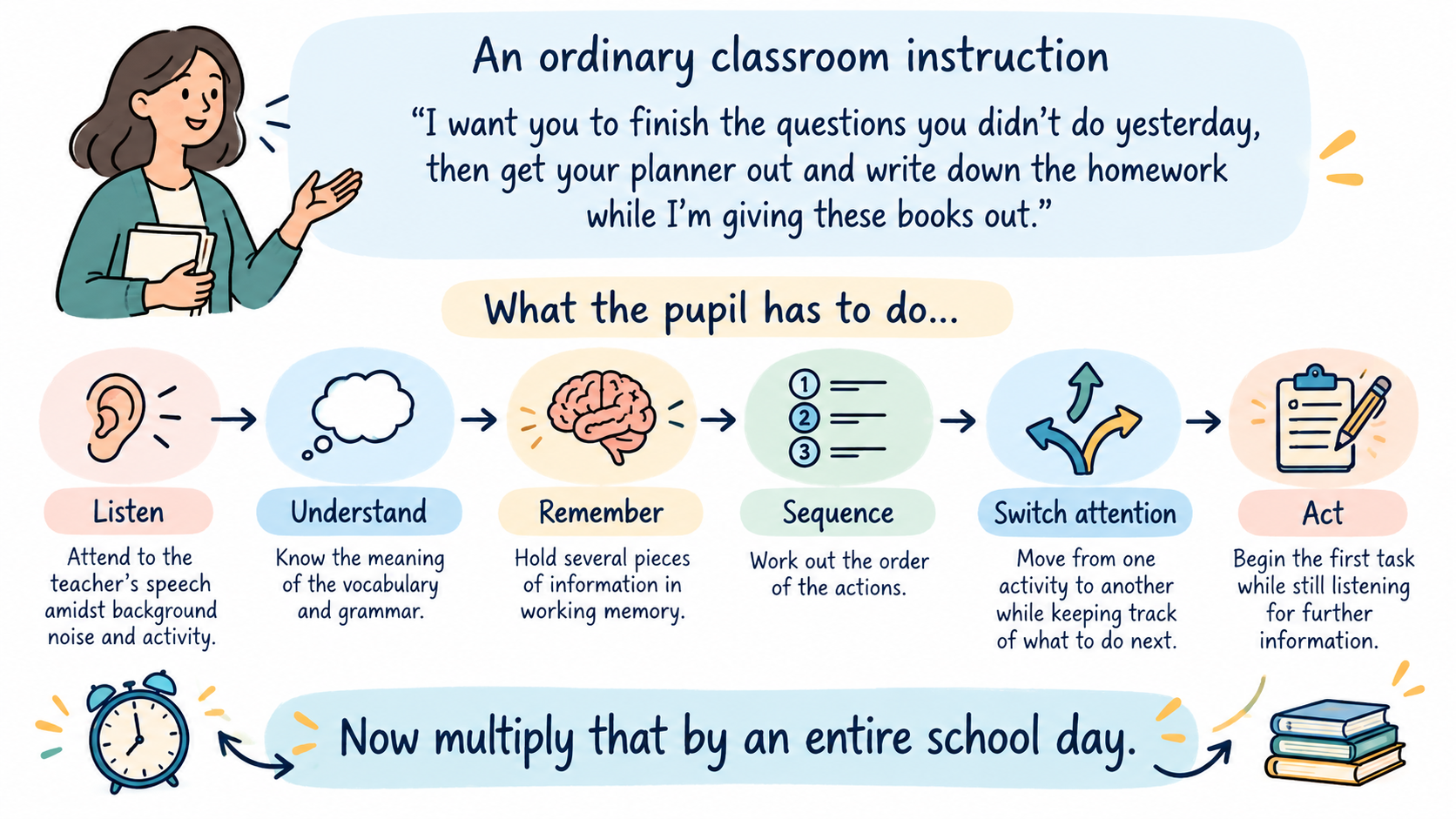
Now multiply that by an entire school day!
Communication demands don’t stop when the lesson ends
In lessons, pupils have to listen, understand vocabulary, make inferences, formulate explanations and answer questions.
During group work, they have to take turns, negotiate, work out what other people know, explain their ideas and disagree appropriately.
At break and lunchtime, the demands change again. Conversation is faster and less predictable. Pupils need to understand humour, teasing and implied meanings, know when and how to join a group and respond quickly enough to keep a conversation going.
Pastoral conversations require yet another set of skills: describing feelings, remembering events and giving a coherent account of what happened.
And when something goes wrong, we may ask a child who is already upset, angry or overwhelmed to explain themselves clearly – at precisely the moment when their communication resources are least available.
Communication is not simply another skill used at school. It is the means through which almost the entire school day is negotiated.
Why can these difficulties be so difficult to spot?
This brings me back to my first few weeks in that new job.
Nobody knew how much I was struggling because I didn’t tell them. I withdrew. I found quiet spaces. I avoided situations I thought would add to the demands I was already experiencing. Outwardly, I continued to function.
Children can do something very similar.
A pupil who hasn’t fully understood may:
copy another pupil;
nod;
say “yeah”;
stay quiet;
guess;
complete the first part of an instruction and forget the rest;
avoid situations they find difficult.
It can look like compliance. But apparent compliance doesn’t necessarily mean understanding.
Other pupils respond differently. When the demands become too great, their frustration may appear as distraction, disengagement, opposition or disruption.
The outward behaviours are very different, but the question we need to ask is the same:
What is this situation asking this child to understand, remember, interpret and communicate?
Looking beneath behaviour
Some children experiencing these difficulties will have identified communication or learning needs. Some may be autistic, have ADHD or Developmental Language Disorder. Others may have no diagnosis at all.
But we don’t need to wait for a diagnostic label before we start looking at communication demands.
If a child repeatedly struggles in particular situations, it is worth examining not only “What is wrong with the child?” but also “What is happening around them?”
Is the language too complex?
Are there too many instructions at once?
Does the pupil have enough processing time?
Are expectations clear?
Is the environment noisy or distracting?
Does the child understand the unspoken social rules of the situation?
Are we asking them to explain themselves at a point when they are already overwhelmed?
These are small questions, but they can fundamentally change how we interpret a child’s behaviour.
Do children need more intervention – or fewer unnecessary barriers?
Teachers frequently tell me how frustrating this can be. They are already working hard to engage pupils, differentiate learning and provide additional support, yet some children continue to struggle.
Our instinct is often to add something: another intervention, another programme, another support session.
Sometimes that is absolutely necessary.
But sometimes we also need to look in the opposite direction.
What could we remove?
Could we reduce unnecessary language?
Could we make expectations clearer?
Could we give more processing time?
Could we make communication more predictable?
Could we teach the communication skills that are genuinely needed rather than simply expecting children to acquire them?
This isn’t about making school easier or lowering expectations. It is about making sure that the communication demands of an activity serve a useful purpose rather than inadvertently becoming a barrier to participation and learning.
A challenge: look at the school day through the lens of communication
When I struggled in that new job, I didn’t suddenly become less competent. My abilities hadn’t disappeared.
For a while, the demands placed upon me simply exceeded the resources I had available to meet them. Once I understood that – and changed some of the conditions around me – I began to thrive.
That experience has stayed with me because I wonder how many children spend their school day in a similar position.
They may be capable. They may be trying very hard. They may even appear to be coping.
But underneath, they may be using enormous amounts of energy simply trying to keep up with what is being asked of them.
So here is a challenge. Choose one ordinary lesson, transition, lunchtime or classroom activity and watch it through the lens of communication.
What does a pupil actually have to understand, remember, infer and communicate to succeed here?
Where might the hidden barriers be?
What could we change about the environment before asking the child to change?
In my next post, I’ll look at some practical ways teachers and parents can reduce unnecessary communication demands while strengthening the communication skills children need for school – and for life.
Because sometimes the first step towards helping a child communicate better isn’t asking them to do more.
It’s noticing just how much we’re already asking them to do