Online Therapy: More Than a Convenient Alternative
Surely speech and language therapy works better when the therapist and child are in the same room?
It’s a reasonable question – and sometimes the answer is yes.
For very young children, for some types of speech work, or where therapy needs to involve physical play and hands-on interaction, being together in the same room may be important.
But online therapy isn’t simply face-to-face therapy transferred onto a screen. Used thoughtfully, it creates a different therapeutic environment – and for some children and young people, that environment can work surprisingly well.
So perhaps the more useful question isn’t:
“Is online therapy as good as face-to-face therapy?”
but:
“Which therapeutic environment is most helpful for this particular child, this particular goal and this stage of development?”
Who can benefit from online therapy?
Online speech and language therapy can be particularly effective with older primary-aged children, teenagers and young adults.
Depending on the individual, it can be used to work on areas including:
speech clarity and intelligibility
organising ideas and expressive language
conversation and social communication
understanding how conversations work
confidence in speaking
self-advocacy and communicating needs
communication associated with autism or developmental language differences
communication skills needed for secondary school, further education and increasing independence.
Suitability always needs to be considered individually. But sometimes the online environment offers advantages that aren’t immediately obvious.
Sometimes the screen actually helps
We tend to assume that communicating through a screen makes interaction harder. For some children and young people, however, it can do the opposite.
Being in the same room with another person involves managing a great deal of information at once: physical proximity, facial expression, gesture, eye gaze, body language, conversational timing and the environment around us.
For a young person who already finds interaction demanding, reducing some of that load can be helpful.
At home, they may also be in a familiar environment where they feel more comfortable. The screen creates a clearly defined space for the interaction and can give the young person a little more control over how they participate.
I have also found that this can change the dynamic of therapy with teenagers.
Instead of feeling as though they have been brought to an appointment to “do therapy”, an online session can feel more like a collaborative conversation. We can look at a problem together, discuss what happened and work out possible strategies.
That difference matters.
Bringing the young person’s real world into therapy
One thing I particularly like about online therapy is how easily we can use the young person’s own interests and experiences.
We might share a game or hobby, watch and discuss a short video clip, analyse a conversation from television, research something together, look at visual material, practise a presentation, or talk through a communication situation that happened during the week.
For older children and teenagers especially, this can make therapy feel relevant.
Rather than practising a skill simply because it is part of a therapy activity, they learn it for a reason.
What happened? Why was that conversation difficult? What could you do differently next time?
Those questions can be much more useful than simply telling a young person what they “should” say.
Learning how conversations actually work
Online sessions can be particularly useful for exploring conversation and social communication.
Conversation is an extraordinarily complex skill. We have to know when to speak, when to wait, how to show we are listening, how to introduce a topic, how to recognise when someone hasn’t understood us and how to repair the conversation when things go wrong.
We also need to learn how to ask effective questions, explain an idea, express disagreement, understand another person’s perspective and advocate for ourselves.
These are not just “social skills”. They are communication skills that become increasingly important as young people move through secondary school and towards adult life.
In an online session, the conversation itself becomes both the activity and the thing we are examining.
We can stop, think, reflect and try something differently.
Moving towards independence
As children get older, I think the nature of therapy needs to change too.
Therapy shouldn’t always involve an adult directing activities while the young person completes them. Increasingly, we want the young person to understand their own communication and develop strategies they can use independently.
That might mean learning to:
identify a difficulty → think about what happened → understand why → develop a strategy → try it → decide whether it helped
The therapist’s role gradually changes too – from directing the session towards helping the young person to reflect, problem-solve and make decisions about their own communication.
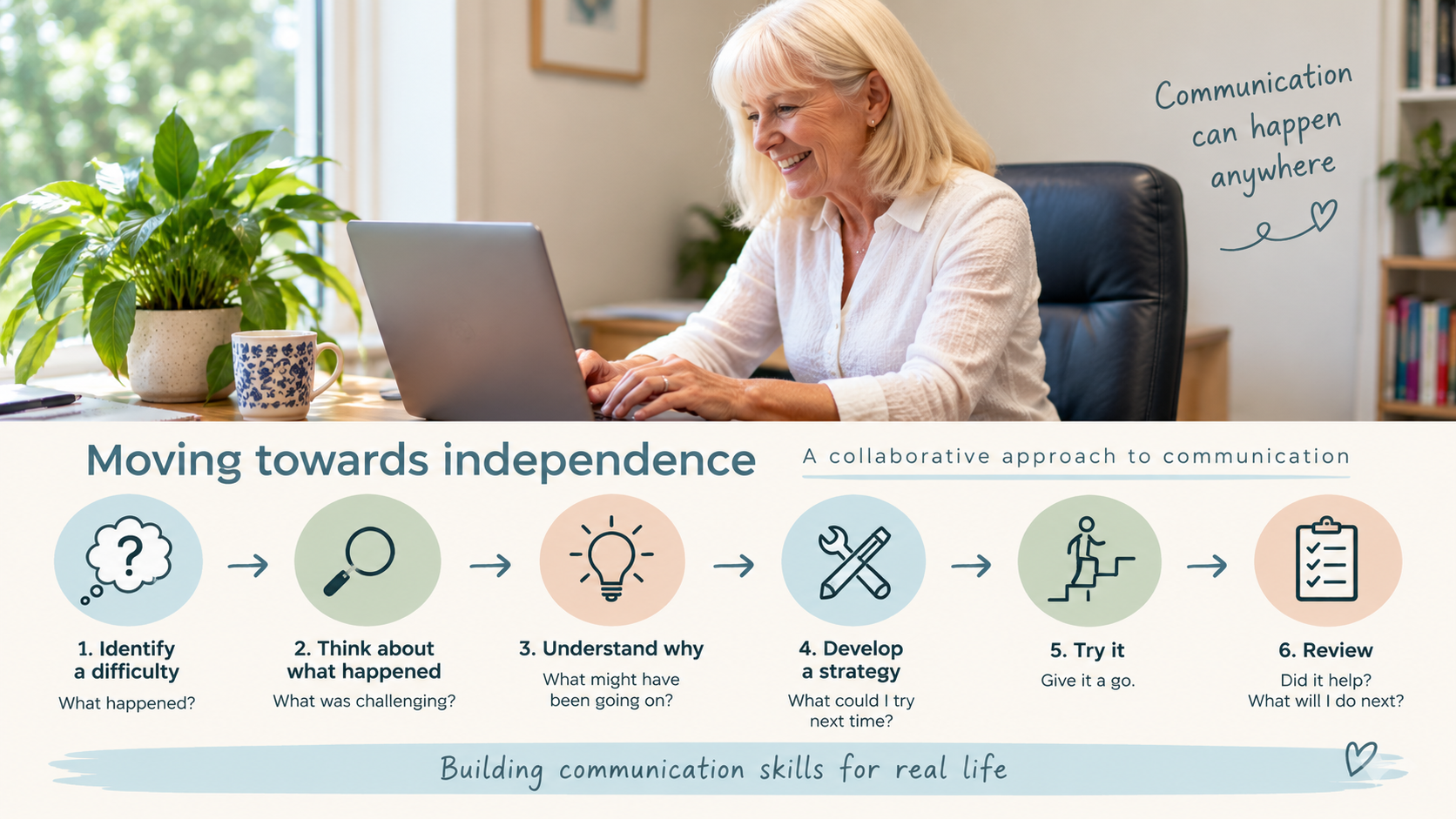
Online therapy can lend itself particularly well to this more collaborative approach.
And yes, the practical benefits matter too
There are, of course, practical advantages.
There is no travelling. Appointments can often fit more easily around school and family life. Therapy can continue if a family moves or circumstances change. And children and young people can access specialist expertise that may not be available locally.
Geography doesn’t necessarily have to determine which specialist a child can see.
But for me, these are additional benefits rather than the main reason for offering therapy online.
The more important question is whether it provides a good environment for that particular young person to learn.
When online therapy isn’t the right choice
Online therapy isn’t suitable for everyone.
Younger children benefit much more from play-based, face-to-face interaction. Some speech-sound interventions are easier when the therapist can observe the child closely in person. Other children simply find screens difficult or struggle to engage in an online session.
Sometimes 1:1 therapy, in person or online, isn’t the best option at all.
A consultation with parents, working with school staff, or a combination of approaches may be more useful.
Choosing the format of therapy should therefore be part of the clinical decision-making process, rather than something decided simply for convenience.
Good therapy is about what happens beyond the session
Online therapy isn’t a second-best version of therapy in a room.
For some children and young people, it provides exactly the distance, structure and flexibility they need to think about communication differently.
For others, face-to-face work will be the better choice.
Ultimately, good therapy isn’t defined by where it takes place. It is defined by whether the child or young person can engage, understand what they are learning and, most importantly, use it where communication really matters – in everyday life.
If you are wondering whether online speech and language therapy might be suitable for your child or young person, you are welcome to get in touch. We can talk about their communication needs and whether online therapy, face-to-face work, consultation, or a combination of approaches is likely to be most helpful.